

- This event has passed.
Not All Accountants Are Forensic Accountants
Not All Accountants Are Forensic Accountants — Understanding the Difference Before It Costs You Millions
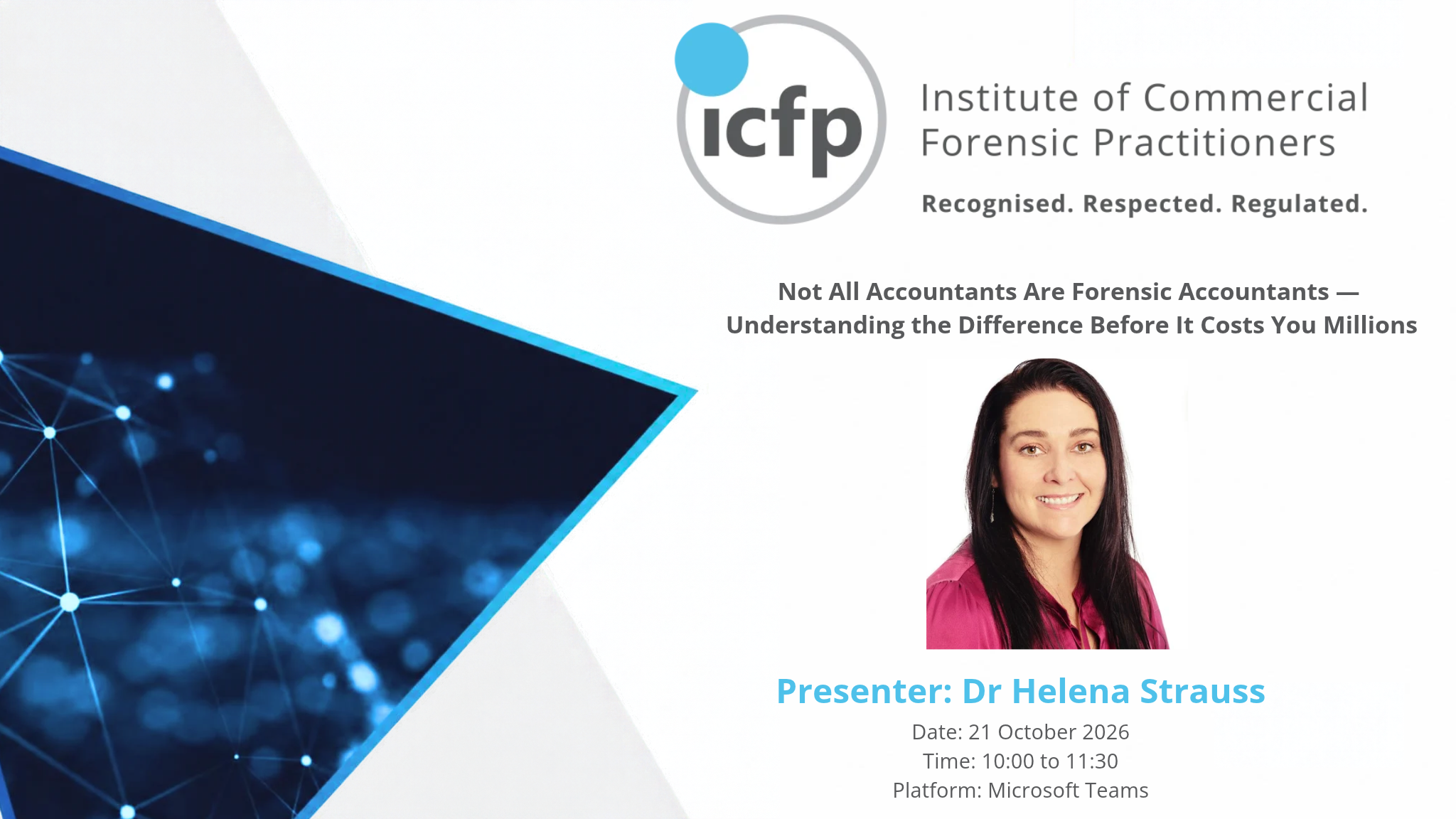
You’re invited to a webinar hosted by the Institute of Commercial Forensic Practitioners NPC (ICFP).
Date: 21 October 2026 from 10:00 to 11:30
Platform: Microsoft Teams
If an accountant is good with numbers, and a forensic accountant is also good with numbers — what exactly makes the forensic accountant different?
It’s a question worth asking before you’re relying on the wrong expertise in a matter where millions are at stake. Just as courtroom experience doesn’t turn a general practitioner into a medical specialist, exposure to litigation doesn’t turn a general accountant into a forensic one. Forensic accounting is a specialisation in its own right — with its own body of knowledge, investigative methods, evidential standards, and professional architecture.
In this session, we’ll unpack:
The core distinction — general accounting asks “are these transactions correctly recorded and reported?” Forensic accounting asks why the transaction happened, who authorised it, who benefited, and whether the conclusion can survive legal scrutiny.
Following the money — using a hypothetical R10 million payment, we’ll trace the full forensic pathway: beneficial ownership, authorisation, connected parties, and ultimate beneficiaries.
The “unknown unknowns” — the competencies a skilled accountant may simply never have been trained in: evidential procedure, fraud examination methodology, interviewing, digital forensics, and evidence preservation.
Same numbers, different conclusions — real-world scenarios (director payments, redirected remuneration, property purchases, unexplained transactions) showing how forensic and non-forensic reviews of identical figures can reach entirely different conclusions.
Beyond fraud — forensic accounting’s role in commercial disputes, shareholder and matrimonial matters, insurance claims, damages quantification, and regulatory investigations.
The evidence problem — the gap between a tidy reconciliation and a conclusion that can withstand cross-examination.
Digital evidence — why the modern forensic accountant investigates the transaction and the digital ecosystem around it.
The expert witness question — what actually qualifies someone to give forensic opinion evidence, beyond simply having appeared in court before.
The closing proposition: the question isn’t whether someone is a good accountant — it’s whether they’re qualified and experienced for the specific forensic question you’re asking them to answer.
Whether you’re a legal practitioner briefing an expert, a business leader assessing risk, or an accountant considering the forensic specialisation, this session will sharpen how you tell the difference — before it costs you.
Register now to secure your spot on MS Teams.